A community of difference
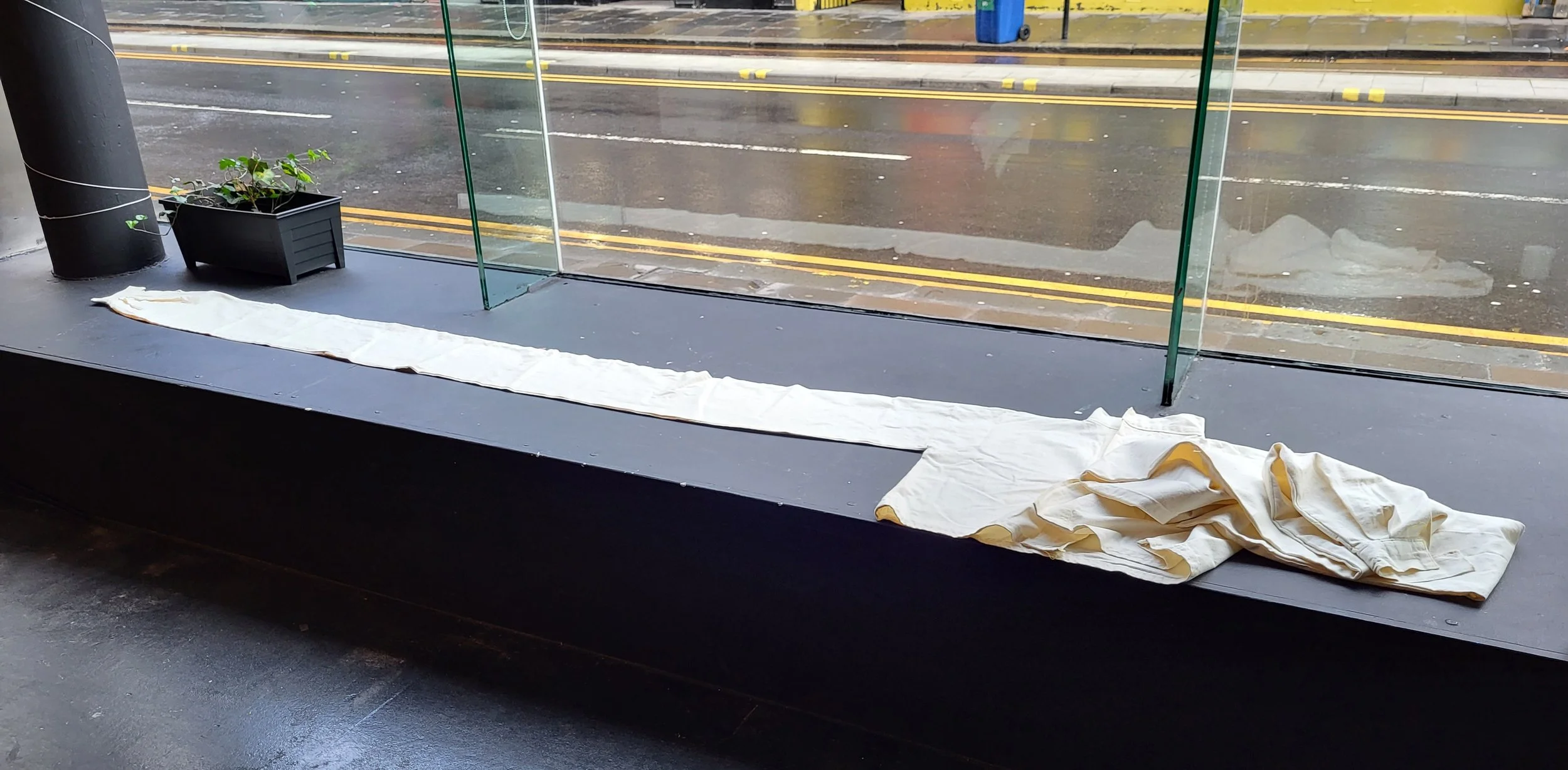
Long sleeve: An exhibit in the HUM-IT collective What it Means to be Human exhibition at Transmission Gallery
Glasgow, after a restless night in an unfamiliar bed. A sodden, grey overcoat of a morning in early December, rain needling into ankle-deep puddles. I shudder as the steamed-up bus jolts over potholes, guiltily filling a seat designated for the elderly or disabled. Despite the silver hair, it’s obvious I’m neither.
Slim and fit looking, without sticks or wheelchair, I’ve run a half marathon, twice walked from one coast of Scotland to the other, was part of a team that virtually rowed the Equator. Yet, today, I’m too tired to stand, too unsteady to walk to the back of the bus. An invisible contradiction, painfully aware of my difference and tensed for confrontation that doesn’t come, I’m crossing my old city in search of community.
In Transmission Gallery, the light is clear, the air bright as a dozen or so strangers, people whose genders sit within and beyond the binary, shrug off coats, gloves and woolly hats, unsure what the day’s workshop will ask of us and what we each have to give. Representatives of the human race and the wryly self-designated living dead, we are nervous, resilient, damaged, powerful. Each keeper of a personal alphabet of secrets, from ADHD, autism, bipolar, EDS, fibromyalgia and MCAS to POTS*. Trickster conditions that cluster together, their precise effects are unique to each of us: here one day, there the next, then vanished, then everywhere.
We are all human
We’ve come together to explore what being human means to those of us with hidden disabilities, with skin, joints, guts and brains that refuse to behave as society says they should. Artists, scientists, wordsmiths gathered to share our similarity and our difference. To talk about ways our experience might be brought to life for others, so that it can be seen and heard without words.
We take in artworks depicting the stretch of our pain, try on jackets fashioned with unwieldy sleeves, unexpected flaps and hidden weights to mimic our awkwardness and burden. We talk, we laugh, we eat. (The lunch provided is so delicious I wolf down two platefuls of spiced spinach, dhal, chickpeas and rice, even though I know the generous use of garlic and onions will trigger days of gut misery.)
We question: When did you realise you had hypermobile EDS? How did you find out you were neurodivergent? What painkillers work for you? I confess that I’m tearful, unused to being in the company of other bendy, off-kilter people with fizzy brains, limbs that twitch, itch, numb and dislocate. Being with them, I know who I am.
We focus on the problem of arms: tools we rely on, appendages that get in the way at night even when scrunched, dinosaur-like, at elbows and wrists. We trade stories about headfuls of hair buzzcut because the weight was too much to bear when migraine struck, about mouthfuls of childhood teeth torn out because they wouldn’t give way, of adult teeth crumbling in their sockets despite the best of care. All part of the price we pay.
Clothes to cast a spell
We weigh up how much of our discomfort we should share publicly, whether it’s unfair to inflict too much of our frustration and exhaustion on others. Would it be possible, we ask, to make a whole wardrobe of unbalanced, weighted garments, from socks and trousers to shirts and scarves, coloured, beaded, buttoned and beribboned to belie the misery of wearing them? Helmets constructed to pinch and destabilise? Glasses with lenses that distort and dysregulate? Clothes and accessories to cast a spell.
In earlier ages, we would have lived – and died – as witches for our inability to conform. Today, we are a brief convention of seers, united in our understanding of the painful, glorious, diverse nature of what it is to be human.
* To make hidden disabilities alphabet soup
Add any form, or forms, of neurodivergence from the list below to a base of EDS (Ehlers-Danlos syndrome) and flavour with one or more of the other ingredients. My personal recipe is autism, hypermobile EDS and MCAS. (Other invisible conditions not listed may be substituted.)
ADHD/attention deficit hyperactivity disorder A neurodevelopmental condition characterised by difficulty focusing, organising and remembering, and/or hyperfocus, and/or restlessness and impulsivity.
Autism A largely genetic neurodevelopmental difference influencing communication, social interaction and behaviour, frequently including sensory sensitivities, focussed interests and a preference for routine.
Bipolar A form of neurodivergence affecting mood and energy, characterised by periods of hypomania, mania and depression.
EDS/Ehlers-Danlos syndrome A painful and exhausting multi-form genetic collagen disorder affecting skin, joints, organs and brain, most commonly characterised by hypermobility.
Fibromyalgia A chronic condition causing widespread pain, fatigue, sleep difficulties and cognitive issues.
MCAS/mast cell activation syndrome An immune disorder characterised by over-release of chemicals, such as histamine, causing body-wide allergic-type symptoms.
POTS/postural orthostatic tachycardia syndrome A disorder of the autonomic nervous system causing dizziness, fainting, fatigue, palpitations and/or brain fog.
What it Means to be Human is a project navigating the intersection of invisible (dis)abilities, neurodiversity and gender identity, led by the HUM-IT collective and supported by the Wellcome Trust through Strathclyde Collaborative Research Cultures funding: Cultures of Collaborative Research in a Socially Progressive Technological University — Grant 228116/Z/23/Z, University of Strathclyde.